
Country lessons in piloting accountability mechanisms for climate action
Current climate finance and governance challenges include a lack of availability and affordability of finance, inequitable distribution of finance, and a lack of effective coordination mechanisms between relevant government ministries and departments, as well as between government and civil society, to name a few. To help overcome these, robust accountability and transparency mechanisms are required to ensure climate finance expenditure is responsible and equitable. A lack of accountability can also exacerbate the impacts of climate change, with recent evidence showing that inadequate social safeguards can increase the risk of maladaptation in one out of every six adaptation projects. For Global South countries, where climate disasters are increasing in both frequency and severity, climate action requires an all-of-society approach, ensuring that vulnerable people are included as partners (rather than beneficiaries) in climate finance decisions.
To ensure commitments to climate action are upheld and that climate finance is accurately monitored and tracked, accountability and transparency frameworks are being integrated into global climate policy processes. For example, under the United Nations Framework Convention on Climate Change (UNFCCC), the Enhanced Transparency Framework and Biennial Transparency Reports provide standardised frameworks and timelines for countries to report on the achievement of their Nationally Determined Contributions (NDCs). Through these processes, governments are incentivised to ensure that their national systems for the measurement, reporting, and verification of greenhouse gas emissions are robust and that NDC implementation is accelerated. At COP28 in 2023, the first-ever Global Stocktake took place, which aims to assess countries’ collective progress on meeting the Paris Agreement’s goal of limiting global warming to below 1.5°c. The Stocktake confirmed that we are currently not on track to meet this goal, with the final outcome text including a historic agreement to “transition away from fossil fuels in energy systems.” The UNFCCC has also established a two-year UAE-Belem work programme to establish indicators to measure progress on the achievement of the targets under the Global Goal on Adaptation – a significant step forward for the adaptation agenda. The finalisation of the adaptation indicators will be a key priority at COP30 later this year.
Several national and subnational governments are also implementing climate finance accountability mechanisms, such as climate finance and data portals, as well as climate budget tagging systems. In addition, citizens and civil society organisations (CSOs) are spearheading initiatives aimed at increasing advocacy for their climate change needs, ensuring that government and policy development processes are inclusive, well-informed, and transparent. For example, in Senegal, CSOs, grassroots actors, and government ministries and departments (including national parks and local city councils) are working together through social engagement pacts to monitor the implementation of the National Strategy for Mangrove Ecosystem Management (SNGM). This initiative is being spearheaded by Enda EcoPop, one of the 25 grantees supported through the Green Accountability Platform, implemented by the World Resources Institute, SouthSouthNorth, and the Huairou Commission. This includes both longstanding NGOs with deep environmental governance expertise and more nascent grassroots organisations working with Indigenous Peoples and Local Communities across Senegal, Cameroon, Mexico, Bangladesh, and Brazil.
While the Green Accountability Platform offers valuable insights into stories of success, innovation, and trust-building between communities and government, it also presents a realistic picture of the current challenges faced within different political contexts. In this blog, examples from Bangladesh, Senegal, and Mexico showcase how CSOs are working to advance the climate accountability agenda by ensuring climate finance and climate action are transparent, responsible, and inclusive, despite the barriers and challenges faced.
Enhancing the transparency of WASH climate finance data amidst political uncertainty in Bangladesh
Bangladesh faces several climate and development challenges. The country’s dense population often incurs natural disasters resulting in flooding, saltwater intrusion and damage to basic services infrastructure. This is particularly concerning for the country’s Water, Sanitation, and Hygiene (WASH) sector, with only 59% of the population having access to safely managed water and only 39% having access to safely managed sanitation. The Bangladesh National WASH Accounts 2020 shows that WASH spending per household is approximately 4.3% of their annual household income, with poor households often spending much more than this. Climate finance for the WASH sector has also been declining in recent years, with a substantial portion of this finance being provided as loans, putting further strain on the country’s development challenges. While 25 ministries have been identified as relevant to climate finance, only nine have recently been active in expenditures related to WASH projects, showcasing missed opportunities to enhance the resilience of the sector and improve vulnerable people’s livelihoods.
To enhance the provision of finance for climate resilient WASH projects, and track the expenditure thereof, WaterAid Bangladesh, in collaboration with the Center for Research and Participatory Development and ACME AI, aims to create a platform to make WASH climate finance more accessible and accountable by facilitating dialogue among stakeholders across three climate zones in Bangladesh. The WASH climate finance platform will not only provide up to date, verified WASH climate finance information (through various avenues such as WaterAid’s existing budget advocacy work and existing climate finance data through the Ministry of Finance’s Climate Finance Cell), but it will also support the education and inclusion of vulnerable communities in the three climate zones. These communities are being consulted throughout project implementation, ensuring that their needs are integrated into the project’s design. These consultations and the platform itself will help to build trust between government and civil society, creating feedback loops to support climate finance flows. The Platform will also be inclusive in its design, being made available in both English and Bengali and will be disseminated in various formats (with proactive outreach to women’s groups) to ensure access to those who have limited internet connectivity.
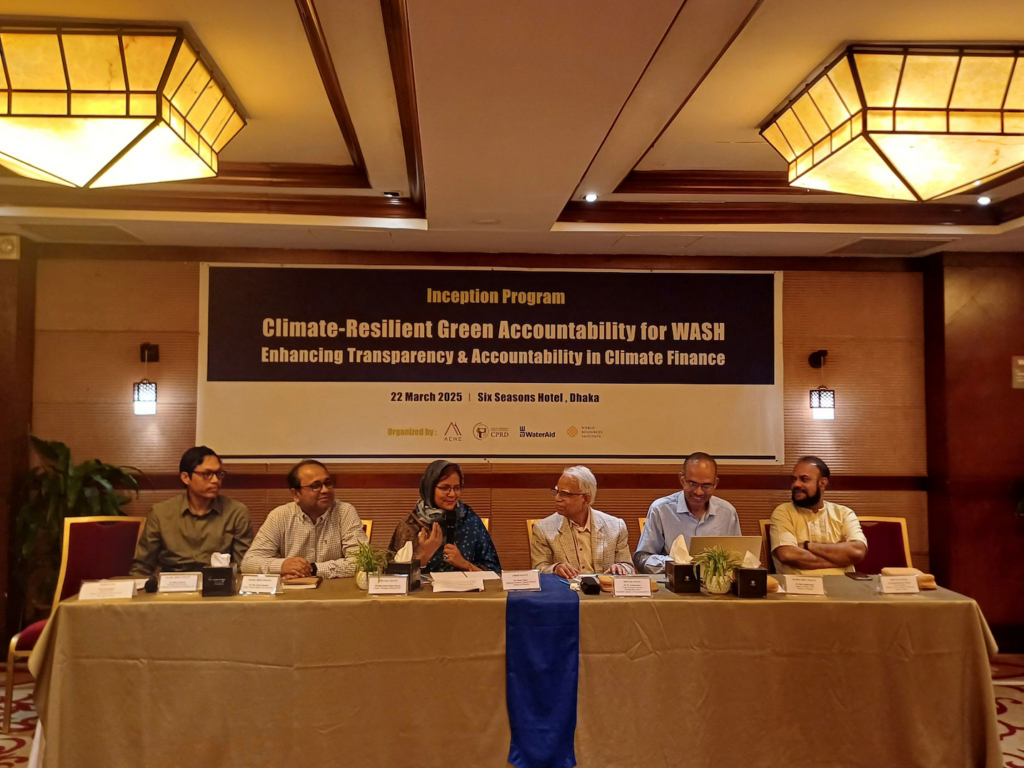
Image: Inception workshop for the Climate-Resilient Green Accountability WASH project.
While Bangladesh has progressed in making climate finance transparent and accessible in recent years (e.g. the release of the Climate Financing for Sustainable Development Budget Report 2024-2025 and establishment of the Bangladesh Climate Change Trust Fund), several challenges remain. For example, the Climate Finance Cell often lacks up-to-date climate finance data, despite its intention to provide publicly available information on international climate finance flows to the country. Bangladesh is also going through a transition. An interim government is currently in place, which has created ongoing operational and governance challenges, including changes in government staff, with some positions being left unfilled. Organisations with long-standing working relationships with the government have been forced to adapt to this uncertainty, shifting their work plans and operating without access to government information.
The political situation has created significant barriers for the Bangladeshi implementing partners of the Green Accountability Platform, as transparency and access to government information remain limited. However, through its Green Accountability grant, WaterAid and its partners are working to overcome the transparency challenges the country now faces so strongly. By working directly with communities at the forefront of climate change, the project will help to raise awareness of both the needs and risks faced by communities, and government challenges and development priorities, ensuring Bangladesh remains on track to achieving its climate commitments amidst political uncertainty.
Strengthening the advocacy and engagement of communities in Senegal’s Just Transition
In 2023, Senegal entered a Euro 2.5 billion Just Energy Transition Partnership (JETP) to increase the country’s share of renewable energy from 30% to 40% by 2030, while also increasing energy access and sovereignty. The JETP offers a significant opportunity to accelerate the country’s climate commitments, however current concerns around its implementation include a lack of transparency and inclusive engagement of communities, particularly in relation to the recent discovery and extraction of oil and gas. This has had major implications on the livelihoods of surrounding communities. For example, approval of the offshore Greater Tortue Ahmeyim (GTA) Gas Project resulted in a temporary ban for local fishermen to enter surrounding waters, which affected the incomes of approximately 80,000 fishermen. Other concerns include the environmental degradation and pollution caused by the oil and gas plants having negative knock-on livelihood implications for the surrounding communities. Citizens have also voiced concern regarding the transparency of the financing mechanisms and investment plans for the JETP, noting that current financing mostly comes in the form of loans. The new discovery of oil and gas in Senegal has created tensions between the country’s climate commitments and opportunities for economic growth. However, CSOs and surrounding communities are making their case clear: if economic growth comes at the expense of vulnerable people and the country’s natural resources, it should not be exploited.
Citoyen Actifs pour la Justice Sociale (CAJUST) is one of the implementing partners of the Green Accountability Platform and is working to raise communities’ awareness of the government’s climate commitments, including the JETP, by ensuring that they have access to information, can advocate for their needs, and have access to important decision-making platforms. Specifically, CAJUST is capacitating surrounding communities to develop their own advocacy strategies to enable them to successfully engage with government on the JETP. Media advocacy continues to underpin CAJUST’s work. An innovative video series has been produced, which showcases a comical character presenting to the public authorities the requirements of transparency, justice and equity of the signed JETP, and another showcases a lawyer filing a complaint against the State in court for climate damages. CAJUST also organised a community forum for displaced persons in Saint-Louis, bringing together over 160 participants, including numerous journalists who broadcast the event on various television and radio channels. The forum provided an opportunity for the communities to speak out and raise their voices on their poor living conditions and request relocation to a more appropriate site.
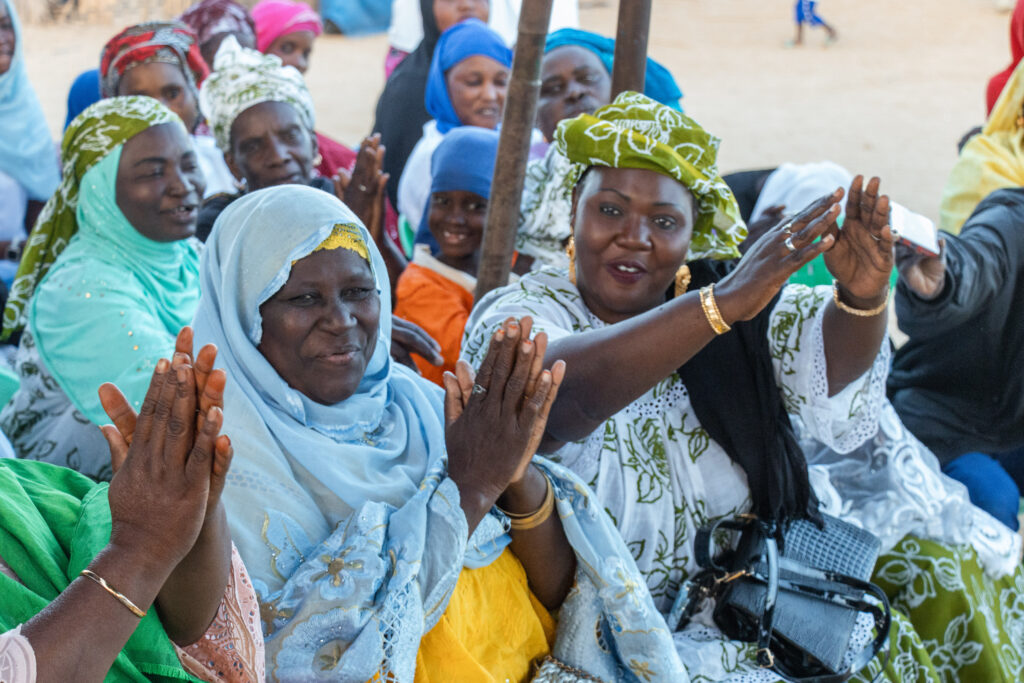
Image: Community forum for displaced people in Saint-Louis.
While there are many concerns from communities regarding the implementation of the JETP, the government is taking active steps to ensure the participation of various stakeholders in the JETP’s plan. For example, a JETP steering committee has been formed, which is led by working groups from the Ministry of Environment and Sustainable Development and the Ministry of Energy, Oil and Mines. The government has also established a multistakeholder body for oversight of the JETP, of which CAJUST is a member. Through its Green Accountability Grant, CAJUST is also actively working to include subnational actors in engagements on the JETP, ensuring geographical equity concerns and governance challenges are not overlooked. Specifically, through innovative and active engagement strategies, CAJUST is ensuring accountability of the government’s implementation of the JETP by ensuring that the most vulnerable voices are accounted for and that climate justice is not abandoned in the pursuit of private sector interests and economic profits.
Developing a Subnational Sustainable Finance Index to support Mexico’s transition pathways
Understanding climate finance flows is more pertinent than ever as the world currently faces substantial cuts in development aid and geopolitical tensions continue to put strain on global relations. Developing countries are now in an urgent position to make sure their national budgets can support their development needs, and this requires robust monitoring and tracking methodologies to understand finance flows. In 2023/2024, only 23 countries had or were in the process of developing climate budget tagging systems, while 40 developing and emerging economies had developed green or sustainable finance taxonomies. While tracking at the national level is important (specifically to support implementation of countries’ NDCs), subnational tracking is especially valuable to ensure national budgets for climate resilient development are being channelled to the very local level.
The Climate Finance Group of Latin America and the Caribbean (GFLAC) has developed a Sustainable Finance Index (SFI) to monitor national and international revenues and expenditures of countries to address climate change and identify those resources that could be hindering progress. The SFI has already provided extensive analyses on expenditures across Latin America and the Caribbean region, with 2020, 2021, 2023 and 2024 reports being currently available. According to the 2024 analysis, countries in the region allocated 12 times more resources to carbon-intensive industries than to climate and biodiversity investments, with most countries allocating less than 1% of their budgets towards climate projects. With the region having a historical dependence on extractive industries, the analysis showcases current opportunities to transition to more sustainable pathways that can have long-lasting positive effects on economic and development growth. This is particularly important for large, dominating economies such as Brazil and Mexico. In 2023, Mexico received 58 times more revenue for carbon-intensive industries and allocated 28 times more resources to polluting sectors as opposed to climate resilient investments. Mexico’s economic dominance in the region provides an opportunity for the country to position itself as a leader in climate-resilient pathways, but this requires aligning current finance allocation to the country’s climate commitments and needs.
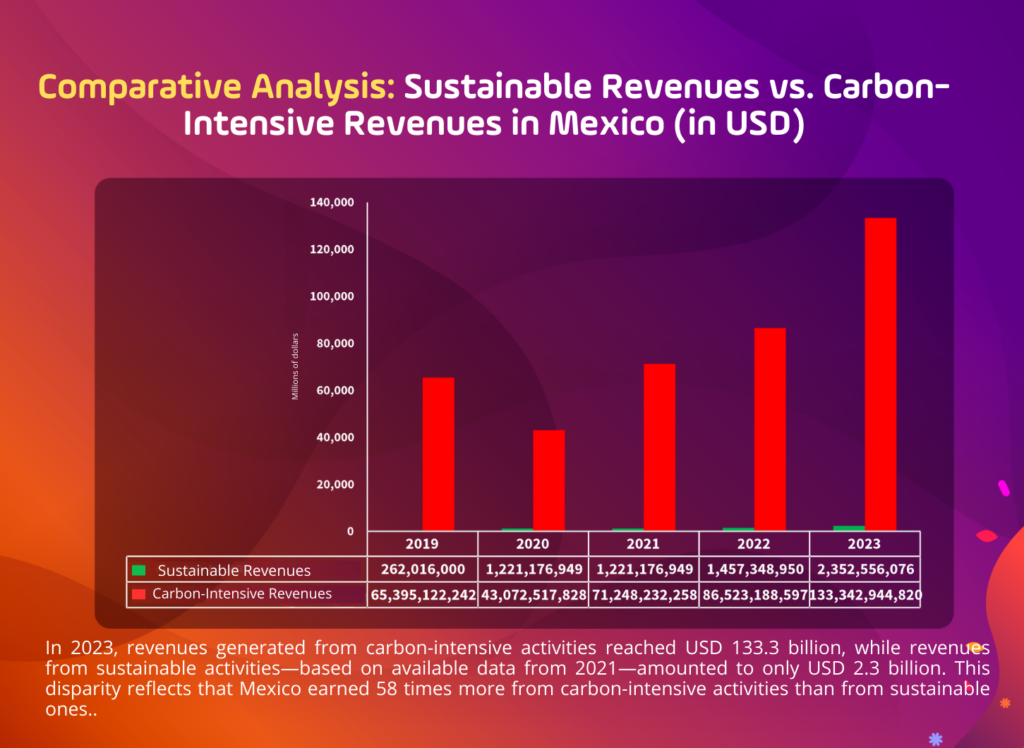
Image: Data and analysis of Mexico’s sustainable and carbon intensive revenues, Sustainable Finance Index, GFLAC.
In 2024, Mexico’s National Institute for Transparency, Access to Information, and Personal Data Protection (INAI) was dissolved, which has created uncertainty regarding access to key public information. GFLAC, with the support of the Green Accountability Grant, will implement the Climate Finance Observatory, which aims to strengthen transparency, access to information, and understanding of the impact of planning and financing processes—both public and private—on climate-related actions. The Observatory will work in close collaboration with local governments, CSOs, and the private sector to ensure multisectoral participation in the evaluation of how climate-related resources are used. One of its core components is the development of a Subnational Sustainable Finance Index, which will enable Mexico’s 32 federal entities to analyse their current allocations to climate finance. Additionally, the Observatory will monitor the implementation of Mexico’s Sustainable Taxonomy, incorporating environmental, social, and gender safeguards, and will generate evidence to support the decarbonization of public budgets and the advancement of a more effective, inclusive, and data-driven climate policy.
Through this grant, GFLAC is taking a leading role in advancing transparency and accountability in climate finance, in alignment with the Regional Agreement on Access to Information, Public Participation and Access to Justice in Environmental Matters in Latin America and the Caribbean—known as the Escazú Agreement – which sets out specific obligations to ensure that environmental information is accessible, timely, and understandable to all people. Through its grant, GLFAC is spearheading transparency of climate finance and expenditure, with this information being useful for incentivising the decarbonising of Mexico’s budgets and transitions to more sustainable development pathways.
Looking forward: SB62 and COP30
With the Green Accountability Platform approaching its halfway implementation mark, the upcoming UNFCCC SB62 June Climate Meetings in Bonn and COP30 in Belem provide important strategic windows to profile current successful accountability and advocacy mechanisms for climate action. Specifically, the Baku to Belem Roadmap to 1.3T must ensure that transparency mechanisms are in place to understand where and how finance is being procured and allocated, ensuring innovative local financing mechanisms can be developed and scaled. The Green Accountability Platform partners will be in Bonn in June to present at a side event on 23 June titled, “Enhancing transparency and accountability in climate finance: Lessons from civil society.” We look forward to continuing important conversations that put CSOs at the forefront of climate finance decisions.
The Green Accountability Platform is a multi-stakeholder initiative launched by the World Bank’s CIVIC: The Civil Society and Social Innovation Alliance (GPSA) in partnership with World Resources Institute, Huairou Commission , and SouthSouthNorth. The Platform deepens engagement with CSOs and grassroots organisations working on the front lines of climate action and helps develop their networks to leverage citizen voice and accountability, with the aim of building systems to enhance the quality, effectiveness, and equity of climate finance.
For more information, please contact Hannah Sack hannah@oldssn.devcorner.co.za